Paule Bellwood, Ph.D. • Jeffrey J. Stegman, B.Sc. • Gary E. Schwartz, Ph.D.
Keywords
Brain Optimization • Human Brain • Cognitive Function • Neuroscience • Focused Life-Force Energy • FLFE
Abstract
The Brain Optimization Program developed by Focused Life-Force Energy (FLFE) aims to enhance cognitive function and mental clarity through the utilization of life-force energy. This pilot study examined the program’s effects on 68 long-term FLFE subscribers over a two-month period. Participants completed a 13-item survey before and after the intervention, assessing various aspects of cognitive function and well-being. Results showed a 7.61% overall improvement across all surveyed items, with notable enhancements in balance and coordination, overall well-being, connectedness, attention, and concentration. The study suggests that the FLFE Brain Optimization Program may offer a novel, non-invasive approach to cognitive enhancement.
Introduction
Brain optimization encompasses a wide range of interventions and techniques to enhance cognitive function, including memory, focus, creativity, and overall mental performance as well as brain health in general [1]. These approaches and techniques range from lifestyle modifications to technological interventions. The field of brain optimization has gained significant attention in recent years, driven by advances in neuroscience research and growing public interest in cognitive enhancement. While the concept of optimizing brain function is appealing, the efficacy and long-term effects of many brain optimization techniques are still being studied.
Focused Life-Force Energy (FLFE) has developed the Brain Optimization Program that aims to improve the cognitive function and enhance mental clarity by directing the life-force energy to clear cognitive haze thus leading to sharper thinking, improved decision making, and a more alert, engaged mind (https://www.flfe.net/). This research study presents formal survey results from 68 FLFE Property subscribers, who had been on the service for one year or longer at the time of the data collection and were offered the opportunity to experience the Brain Optimization Program prior to it being made available to all FLFE subscribers.
Background
Brain optimization and cognitive function enhancement have been subjects of scientific inquiry for decades, with roots in early psychological studies on learning and memory [2-5]. Modern brain optimization research includes a wide range of disciplines, including neuroscience, psychology, nutrition, and technology [3, 6-8].
Key areas of focus in brain optimization are:
Lifestyle Interventions. Research has shown that a healthy lifestyle, including proper diet, sufficient physical activity, sleep optimization, and stress management, can have significant positive effects on brain health and cognitive performance [9-11].
Cognitive Training. This involves engaging in specific mental exercises or tasks designed to improve cognitive skills. While some studies have shown promising results, the transferability of these skills to real-world situations remains a topic of debate [12-14].
Neurofeedback. This technique uses real-time displays of brain activity to teach self-regulation of brain function. It has shown potential in treating certain neurological conditions, such as Attention Deficit and Hyperactivity Disorder, anxiety, depression, and epilepsy, but its efficacy for general cognitive enhancement is still being investigated [15-18].
Neuroplasticity. The brain’s ability to form new neural connections and reorganize itself is fundamental to learning and cognitive enhancement. It can be harnessed for clinical applications and therapeutic interventions [19-22].
Nootropics. Also known as “smart drugs,” these are substances claimed to improve cognitive function. They range from natural supplements to prescription medications. The effectiveness and safety of many nootropics are still under study [23-26].
Neurotechnology. This emerging field includes devices like transcranial magnetic stimulation (TMS) and transcranial direct current stimulation (tDCS), which aim to modulate brain activity directly. While showing promise in clinical settings, their use for cognitive enhancement in healthy individuals is controversial [27-29].
The field of brain optimization faces several challenges, including the need for more rigorous scientific research, ethical considerations surrounding cognitive enhancement, and the potential for unintended consequences of interventions aimed at altering brain function. As research in neuroscience and related fields progresses, our understanding of brain optimization continues to evolve. Future developments may include more personalized approaches based on individual brain characteristics and the integration of artificial intelligence to enhance human cognitive abilities [1, 3, 7, 30-33].
FLFE is a Canadian company offering a consciousness-raising subscription-based service for a property or around an object. The FLFE system is designed to focus available life-force energy and to activate a high consciousness field at a specified location (i.e., legal address or geographic coordinates) or around a personal object (i.e., mobile phone). The higher-level consciousness field, in combination with other enhancements, is intended to increase the beneficial nature of the local environment. The FLFE service claims are extraordinary [34] in terms of mainstream science and various experiments, such as the one detailed in this paper, have been conducted to explore the effects of the purported beneficial environmental changes. FLFE’s experimental philosophy is to first explore the effects (i.e., ‘Is something happening?’) and then, when possible and practical, explore the mechanisms of action. For more information, please see the FLFE Gold Standard research statement (https://www.flfe.net/research).
FLFE’s Brain Optimization Program is theorized to enhance optimal brain function and structure by increasing life-force energy available for the brain. During waking hours, the program primarily focuses on boosting the brain’s performance and is intended to increase alertness, improve cognitive abilities, and sharpen mental clarity, along with increased stamina for demanding tasks and enhanced recall or short-term memory.
Methods
This experiment was conducted in June-August 2019 using a 13-item survey pre and post intervention [Appendix A]. The data were collected at two stages: at Baseline (i.e., FLFE ON, no Brain Optimization Program) and at two months post intervention (i.e., FLFE ON, Brain Optimization Program ON for 2 months) with customers who had been on the FLFE service for one year or longer.
The pre and post ratings of the 13 items were entered into a spreadsheet and analyzed using Statistica for Windows. Averaged scores across the 13 items, as well as individual items were analyzed using between groups t tests.
Results
175 FLFE customers filled out the survey pre intervention and 68 filled out the survey post intervention.
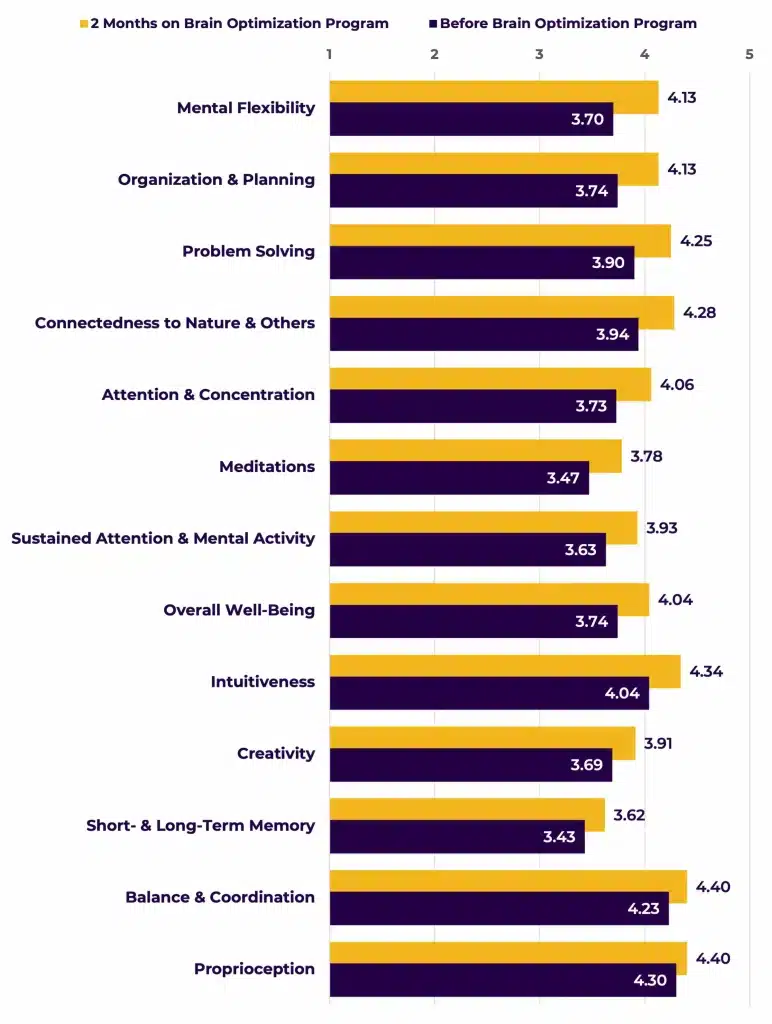
Overall, the average for all 13 survey items increased from 3.81 (out of 5) to 4.10 (out of 5), resulting in 7.61% improvement in the 13 items post Brain Optimization Program implementation.
The bar chart below (Figure 1) shows changes in the 13 experiences reported by FLFE customers associated with increased brain optimization, where 1 represents “Never”, 2 represents “Rarely”, 3 represents Occasionally, 4 represents “Frequently”, and 5 represents “Very Frequently”.
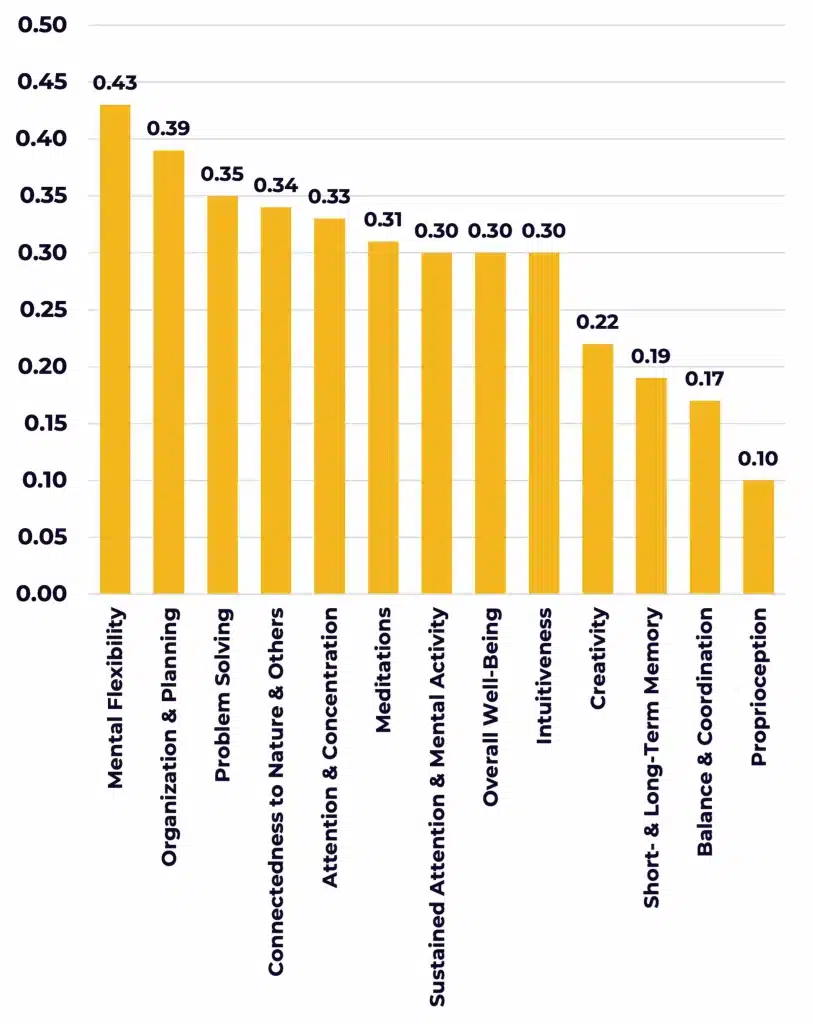
The next bar chart (Figure 2) shows the same 13 items in decreasing order from largest improvements to smallest improvements observed.
Limitations
Since the survey responses were collected anonymously, matching responses from pre intervention survey with post intervention survey was not possible. Since this was a Phase 1 study, control groups were not included, Future Phase 2 studies will include blinded controls. Being able to compare individual changes in experiences post intervention may provide additional insights and information on the effectiveness of the Brain Optimization Program.
Conclusion and Future Directions
The Brain Optimization Program developed by FLFE shows promising initial results in enhancing cognitive function and mental clarity among long-term FLFE subscribers. The pilot study demonstrated a 7.61% overall improvement across 13 surveyed items related to brain optimization after two months of program implementation. Notably, participants reported improved balance and coordination, overall well-being, connectedness to nature and others, attention and concentration, as well as sustained attention and mental activity. These findings suggest that the FLFE Brain Optimization Program may offer a novel approach to cognitive enhancement without pharmacological interventions or invasive techniques. The observed improvements in various aspects of cognitive function align with the growing interest in non-invasive brain optimization methods within the scientific community.
To build upon these encouraging results, several avenues for future research and development are proposed. For example, conducting longer-term studies may help assess the sustainability of cognitive improvements and potential cumulative effects over extended periods. Randomized controlled trials with larger sample sizes may help more rigorously evaluate the Program’s efficacy compared to placebo or other cognitive enhancement techniques. Advanced neuroimaging techniques may help investigate potential neurophysiological changes associated with the Brain Optimization Program. And, finally, mechanism elucidation studies may help understand the underlying mechanisms by which the FLFE’s Brain Optimization Program influences cognitive function.
Regardless of future approaches that may help understand and improve the Brain Optimization Program, ethical implications of cognitive enhancement technologies must be addressed and guidelines for responsible use and implementation must be developed. By pursuing these research directions, FLFE can further validate and refine the Brain Optimization Program, potentially contributing valuable insights to the field of cognitive enhancement and brain health optimization.
References
[1] Farah, M. J., et al. (2004). Neurocognitive enhancement: What can we do and what should we do? Nature Reviews Neuroscience, 5(5), 421-425.
[2] Brem, A. K., Fried, P. J., Horvath, J. C., Robertson, E. M., & Pascual-Leone, A. (2014). Is neuroenhancement by noninvasive brain stimulation a net zero-sum proposition? NeuroImage, 85, 1058-1068.
[3] Dresler, M., Sandberg, A., Ohla, K., Bublitz, C., Trenado, C., Mroczko-Wąsowicz, A., Kühn, S., & Repantis, D. (2013). Non-pharmacological cognitive enhancement. Neuropharmacology, 64, 529-543.
[4] Farah, M. J., Illes, J., Cook-Deegan, R., Gardner, H., Kandel, E., King, P., Parens, E., Sahakian, B., & Wolpe, P. R. (2004). Neurocognitive enhancement: What can we do and what should we do? Nature Reviews Neuroscience, 5(5), 421-425.
[5] Stojanoski, B., Lyons, K. M., Pearce, A. A. A., & Owen, A. M. (2018). Targeted training: Converging evidence against the transferable benefits of online brain training on cognitive function. Neuropsychologia, 117, 541-550.
[6] Gómez-Pinilla, F. (2008). Brain foods: The effects of nutrients on brain function. Nature Reviews Neuroscience, 9(7), 568-578.
[7] Bostrom, N., & Sandberg, A. (2009). Cognitive enhancement: Methods, ethics, regulatory challenges. Science and Engineering Ethics, 15(3), 311-341.
[8] Zamroziewicz, M. K., & Barbey, A. K. (2016). Nutritional cognitive neuroscience: Innovations for healthy brain aging. Frontiers in Neuroscience, 10, 240.
[9] Mintzer, J., Donovan, K. A., Kindy, A. Z., Lock, S. L., Chura, L. R., & Barracca, N. (2019). Lifestyle Choices and Brain Health. Frontiers in Medicine, 6, 204.
[10] Stults-Kolehmainen, M. A., & Sinha, R. (2014). The Effects of Stress on Physical Activity and Exercise. Sports Medicine, 44(1), 81-121.
[11] American Psychological Association. (2020). Working out boosts brain health. Retrieved from https://www.apa.org/topics/exercise-fitness/stress
[12] Simons, D. J., Boot, W. R., Charness, N., Gathercole, S. E., Chabris, C. F., Hambrick, D. Z., & Stine-Morrow, E. A. L. (2016). Do “brain-training” programs work? Psychological Science in the Public Interest, 17(3), 103-186.
[13] Kueider, A. M., Parisi, J. M., Gross, A. L., & Rebok, G. W. (2012). Computerized cognitive training with older adults: A systematic review. PLoS ONE, 7(7), e40588.
[14] Lampit, A., Hallock, H., & Valenzuela, M. (2014). Computerized cognitive training in cognitively healthy older adults: A systematic review and meta-analysis of effect modifiers. PLoS Medicine, 11(11), e1001756.
[15] Enriquez-Geppert, S., Huster, R. J., & Herrmann, C. S. (2017). EEG-neurofeedback as a tool to modulate cognition and behavior: A review tutorial. Frontiers in Human Neuroscience, 11, 51.
[16] Gruzelier, J. H. (2014). EEG-neurofeedback for optimising performance. I: A review of cognitive and affective outcome in healthy participants. Neuroscience & Biobehavioral Reviews, 44, 124-141.
[17] Marzbani, H., Marateb, H. R., & Mansourian, M. (2016). Neurofeedback: A comprehensive review on system design, methodology and clinical applications. Basic and Clinical Neuroscience, 7(2), 143-158.
[18] Thibault, R. T., Lifshitz, M., & Raz, A. (2016). The self-regulating brain and neurofeedback: Experimental science and clinical promise. Cortex, 74, 247-261.
[19] Voss, P., Thomas, M. E., Cisneros-Franco, J. M., & de Villers-Sidani, É. (2017). Dynamic brains and the changing rules of neuroplasticity: Implications for learning and recovery. Frontiers in Psychology, 8, 1657.
[20] Merzenich, M. M., Van Vleet, T. M., & Nahum, M. (2014). Brain plasticity-based therapeutics. Frontiers in Human Neuroscience, 8, 385.
[21] Cramer, S. C., Sur, M., Dobkin, B. H., O’Brien, C., Sanger, T. D., Trojanowski, J. Q., Rumsey, J. M., Hicks, R., Cameron, J., Chen, D., Chen, W. G., Cohen, L. G., deCharms, C., Duffy, C. J., Eden, G. F., Fetz, E. E., Filart, R., Freund, M., Grant, S. J., … Vinogradov, S. (2011). Harnessing neuroplasticity for clinical applications. Brain, 134(6), 1591-1609.
[22] Kolb, B., & Gibb, R. (2011). Brain plasticity and behaviour in the developing brain. Journal of the Canadian Academy of Child and Adolescent Psychiatry, 20(4), 265-276.
[23] Fond, G., Micoulaud-Franchi, J. A., Brunel, L., Macgregor, A., Miot, S., Lopez, R., … & Repantis, D. (2015). Innovative mechanisms of action for pharmaceutical cognitive enhancement: A systematic review. Psychiatry Research, 229(1-2), 12-20.
[24] Suliman, N. A., Mat Taib, C. N., Mohd Moklas, M. A., Adenan, M. I., Hidayat Baharuldin, M. T., & Basir, R. (2016). Establishing natural nootropics: Recent molecular enhancement influenced by natural nootropic. Evidence-Based Complementary and Alternative Medicine, 2016, 4391375.
[25] Froestl, W., Muhs, A., & Pfeifer, A. (2014). Cognitive enhancers (nootropics). Part 1: Drugs interacting with receptors. Journal of Alzheimer’s Disease, 41(4), 961-1019.
[26] Urban, K. R., & Gao, W. J. (2014). Performance enhancement at the cost of potential brain plasticity: Neural ramifications of nootropic drugs in the healthy developing brain. Frontiers in Systems Neuroscience, 8, 38.
[27] Polania, R., Nitsche, M. A., & Ruff, C. C. (2018). Studying and modifying brain function with non-invasive brain stimulation. Nature Neuroscience, 21(2), 174-187.
[28] Brem, A. K., Fried, P. J., Horvath, J. C., Robertson, E. M., & Pascual-Leone, A. (2014). Is neuroenhancement by noninvasive brain stimulation a net zero-sum proposition? NeuroImage, 85, 1058-1068.
[29] Santarnecchi, E., Brem, A. K., Levenbaum, E., Thompson, T., Kadosh, R. C., & Pascual-Leone, A. (2015). Enhancing cognition using transcranial electrical stimulation. Current Opinion in Behavioral Sciences, 4, 171-178.
[30] Greely, H. T. (2013). Enhancement and the ethics of development. Kennedy Institute of Ethics Journal, 23(4), 315-338.
[31] Ienca, M., & Andorno, R. (2017). Towards new human rights in the age of neuroscience and neurotechnology. Life Sciences, Society and Policy, 13(1), 5.
[32] Sahakian, B. J., & Morein-Zamir, S. (2011). Neuroethical issues in cognitive enhancement. Journal of Psychopharmacology, 25(2), 197-204.
[33] Wexler, A. (2017). The social context of “do-it-yourself” brain stimulation: Neurohackers, biohackers, and lifehackers. Frontiers in Human Neuroscience, 11, 224.
[34] Schwartz, G. E. (2021). Extraordinary claims require extraordinary evidence: The science and ethics of truth seeking and truth abuse. Cardiff, CA: Waterside Productions.
Appendix A
This survey is confidential, no information will be associated with your name. We will be using the group survey to track the results from the FLFE Brain Optimization Program. We may share the overall results with the FLFE community. Thank you for your participation!
- My balance and Coordination are excellent.
Never — Rarely — Occasionally — Frequently — Very Frequently
- My proprioception is excellent. (Proprioception – awareness of the position and movement of body)
Never — Rarely — Occasionally — Frequently — Very Frequently
- My attention and concentration are excellent.
Never — Rarely — Occasionally — Frequently — Very Frequently
- My stamina of sustained attention and mental activity is excellent.
Never — Rarely — Occasionally — Frequently — Very Frequently
- My organization and planning are excellent.
Never — Rarely — Occasionally — Frequently — Very Frequently
- My problem solving is excellent.
Never — Rarely — Occasionally — Frequently — Very Frequently
- My mental flexibility is excellent. (capacity to switch to an appropriate mental mode)
Never — Rarely — Occasionally — Frequently — Very Frequently
- My short-term and long-term memory are excellent.
Never — Rarely — Occasionally — Frequently — Very Frequently
- My overall well-being is excellent.
Never — Rarely — Occasionally — Frequently — Very Frequently
- My meditations are excellent. (ability to sit quietly)
Never — Rarely — Occasionally — Frequently — Very Frequently
- I am intuitive. (insight or direct perception without thinking)
Never — Rarely — Occasionally — Frequently — Very Frequently
- I feel creative. (Creativity -imagination and original ideas)
Never — Rarely — Occasionally — Frequently — Very Frequently
- I feel connected to nature and others.
Never — Rarely — Occasionally — Frequently — Very Frequently